
Translation in english available at the bottom
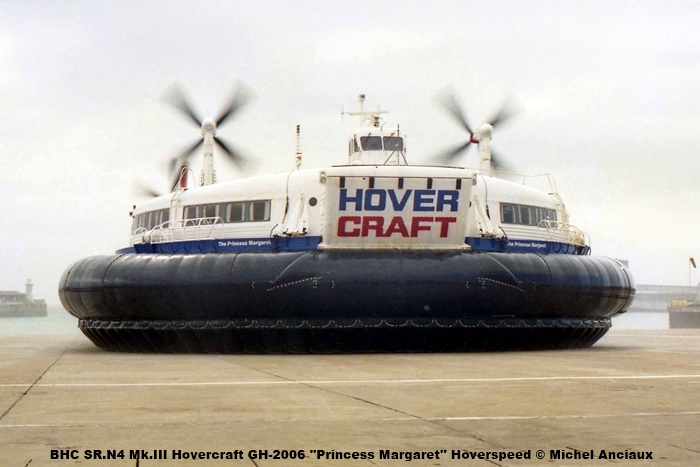
Este reportaje les parecerá fueran de contexto en un sitio donde difundimos temas aeronáuticos, pero si les comento que este medio de transporte comparte ciertos componentes aeronáuticos, estarán quizás de acuerdo conmigo que valió la peina presentarlo.
Lo primero son los motores, una versión ‘’navalizada’’ del Bristol Proteus que propulsaba el Bristol Britania.

En cuanto a la cabina de mando, si no fuera por la falta de horizonte artificial, uno podría pensar que estamos en un avión. La tripulación de mando estaba compuesta de un piloto, un copiloto/ ingeniero ‘’de vuelo’’ y un operador radar/ navegador.
No olvidemos también que, al contrario de un avión o aeronave, este se desplaza en solo dos de las tres dimensiones del espacio.
La BHC-British Hovercraft Corporation, una colaboración entre la Saunders-Roe (división de Westland Aircraft) y la sección hovercraft de la Vickers Supermarine, fue une empresa británica creada en 1966, con el proyecto de producir un medio de transporte hovercraft económicamente factible.
El SR.N4 Mountbatten fue el medio de transporte mixto de pasajeros y vehículos más destacado producido en la BHC y se considera como el aerodeslizador más grande operando en el sector civil.
Los modelos producidos fueron utilizados en servicios comerciales a través del canal de la Mancha, entre agosto de 1968 y octubre 2000.
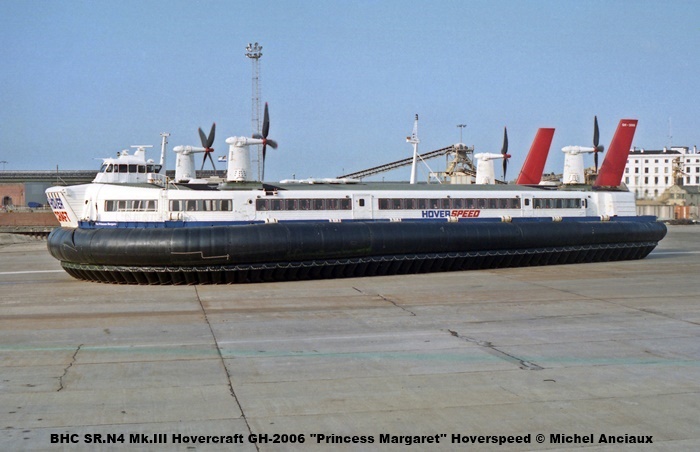
Los estudios y trabajos se iniciaron en el año 1965 para la primera versión, con una capacidad de 254 pasajeros y 30 autos (SR.N4 Mk.I Hovercraft). Sus dimensiones eran 40 metros (131 ft) de largo con un peso de 193 toneladas y una velocidad máxima de 83 nudos (154 km/h) o una velocidad de crucero de 60 nudos (111 km/h).
El prototipo, identificado como 001, fue construido en el mismo hangar donde se armó los tres aviones anfibios Saunders-Roe Princess.
En octubre 1967, fue presentado a la prensa, representativos de clientes potenciales y oficiales del gobierno.
El 20 de noviembre marcó el primero ensayo de motores y el 4 de febrero fue puesta por primera vez al agua. Fue este mismo día que el 001 realizó su ‘’primer vuelo’’.
El SR.N4 estaba propulsado por 4 motores turbo hélices Bristol Proteus de 3400 caballos de potencia, siendo aumentada a 3800 en la última versión Mk.III.
Cada motor venia con un juego de hélices de marca Dowty Rotol orientable, con un diámetro de 5,8m o 19 ft (6,4m o 21 ft en el Mk.III) instalados en dos pares sobre pilones posicionados en la parte superior de la nave, siendo en estos años las hélices más grandes del mundo.

Mencionar el Motor Bristol Proteus, es cubrir más de 50 años de desarrollos, producciones y operaciones de este emblemático motor, relacionado con grandes proyectos y diseños de aviones producidos en Inglaterra: el Bristol Brabazon Mk.II en 1946, el Saunders-Roe SR.45 Princess y Bristol 253 Britannia en 1952 pero también un Proteus 705 especialmente modificado para el automóvil récord de velocidad terrestre Bluebird-Proteus CN7 de Donald Campbell en 1960.
Otras aplicaciones fueron en producción de energía para centrales eléctricas; y por supuesto el Marine Proteus para el Hovercraft SR.N4 y la lancha patrullera rápida Brave-class.
La cabina de mando del aerodeslizador se parecía mucho a un puesto de mando de avión.
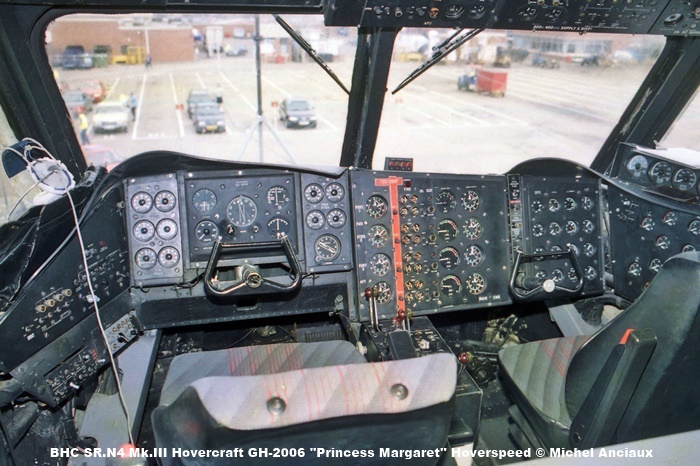
La responsabilidad principal para el operador radar/navegador era de controlar la ruta de navegación con la ayuda del radar Decca 629, a fines de evitar posibles colisiones.

Igual si los controles de vuelos se parecían mucho a los de un avión, con pedales para los timones, Caña de control de dirección, yugos, niveles de paso de hélice separados y controles de velocidad del motor; sus funcionalidades difieran significativamente.
Para completar, un faldón de un peso de 12 toneladas colocada bajo el perímetro completo de la nave, ayudaba en crear el efecto de cojín de aire.
Bolsas flexibles almacenando el combustible estaban colocadas en las cuatros esquinas del SR.N4 y podían ser utilizadas para equilibrar la nave, transfiriendo el combustible entre los estanques de proa y los de popa para equilíbralo y estabilizarlo en base a la carga transportada pero también para enfrentar con mas seguridad las condiciones climáticas del momento.
La nave podía navegar con condiciones de vientos hasta fuerza 8 en la escala Beaufort y oleajes de 3,5m.
FUERZA 8; TEMPORAL
velocidad del viento entre los 34- 40 nudos/ 62-74 km/h. Mar con olas hasta 3,5m de alto.
Condiciones tormentosas y peligrosas para la navegación.
Un sistema de dobles puertas en la popa permitía la carga y descarga de los vehículos.

Un segundo sistema de puerta de carga, en forma de rampa, estaba instalado en la proa.
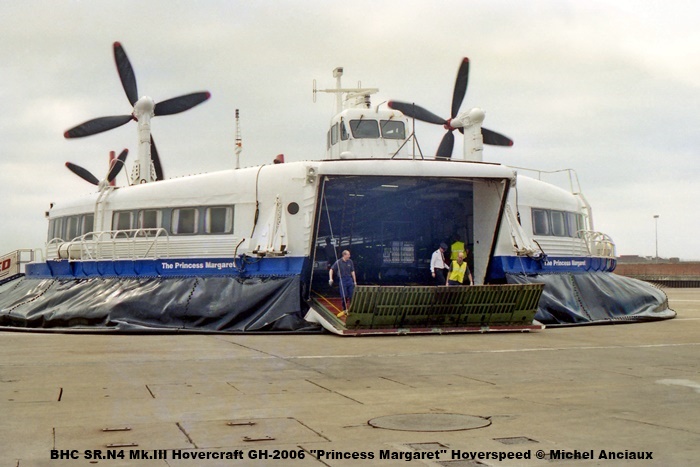
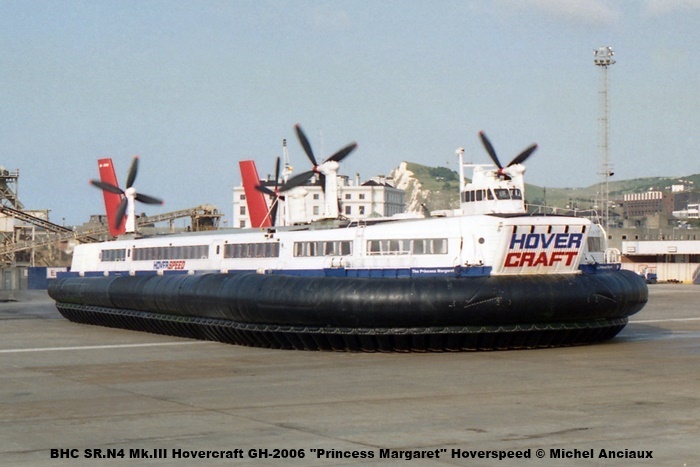
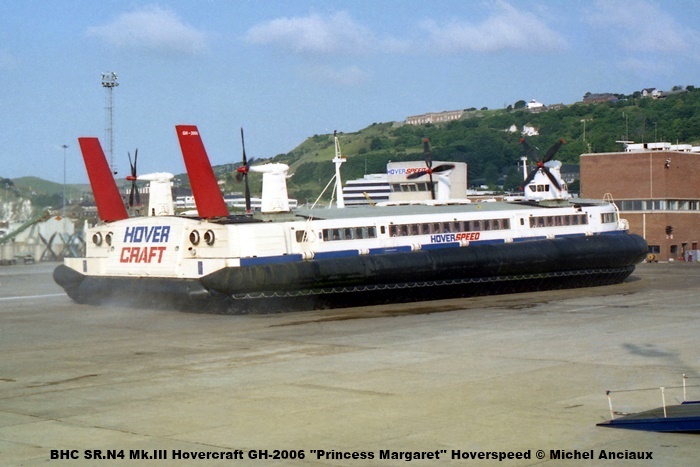
El primero servicio comercial con el SR.N4 se inauguró en agosto 1968 utilizando el GH-2006 ‘’Princess Margaret’’ en los colores de la compañía Seaspeed entre Dover y Boulogne, pero con la entregue de otros aerodeslizador conexiones entre Ramsgate y Calais fueron también inauguradas.
El trayecto desde Dover hacia Boulogne era de aproximadamente unos 35 minutos, a diferencia de 1h30 en barco. Operando hasta 6 travesías al día en las temporadas altas.
Para la empresa Hoverlloyd, la mayoría del personal comercial y tripulantes fueron contratados en el sector del transporte aéreo, siendo una oportunidad entre otras para el personal de British Eagle luego de su quiebra en 1968. Así que la compañía de transporte por Aerodeslizadores operaba más como una línea aérea que como una compañía naviera.
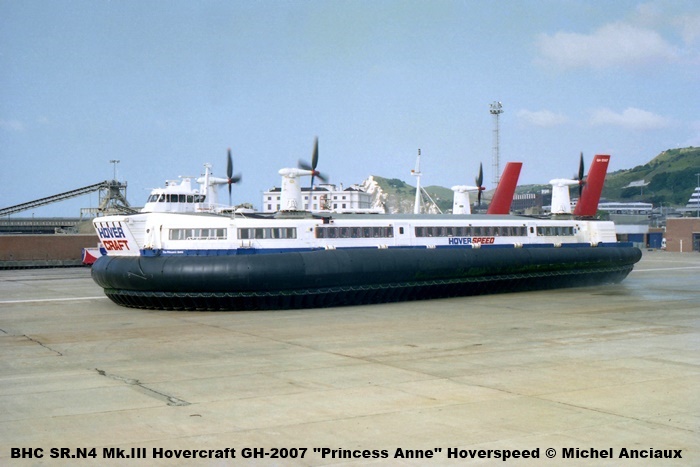
Para la pequeña historia es de mencionar que la travesía la más rápida operada por un aerodeslizador comercial a través del Canal de la Mancha fue registrado el 14 de septiembre de 1995 en un tiempo de 22minutos, con el SR.N4 Mk.III GH-2007 Princess Anne.

La Royal Navy estudio la posibilidad de una versión de dragado de minas del SR.N4, siendo el aerodeslizador casi invulnerable a las minas. Pero también se enfrentó a los costos de operación de este medio.
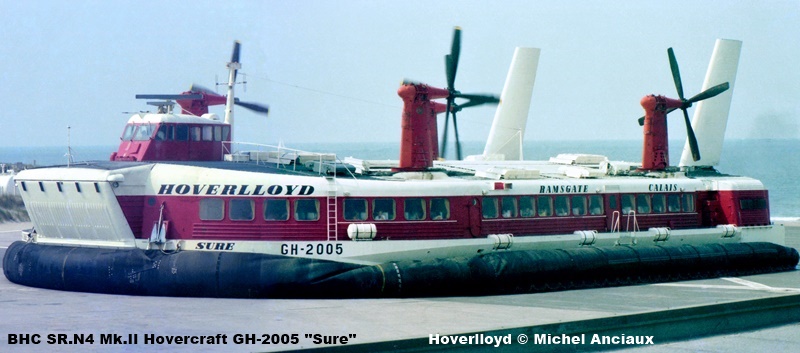
A lo largo de sus años de operaciones, se pidió aumentar la capacidad de transporte resultando en 1973-1974 en una primera variante (SR.N4 Mk.II Hovercraft) con 278 pasajeros y 36 autos, pero sin cambiar las estructura del modelo inicial. El aumento de capacidad fue posible gracias a unos reacondicionamientos de las cabinas de pasajeros.
Y en febrero de 1977 una segunda variante (Mk.III) fue desarrollada, utilizando el GH-2007 Princess Anne quien, a través de los trabajos de ampliación, alargando de 16,7 m (54,2 ft) la estructura de la nave resultando casi en el doble de capacidad de transporte tanto en pasajeros como en vehículos.
Igual si a lo largo de sus operaciones sucedió unos cuantos incidentes benignos, en marzo de 1985 se tuvo que lamentar 4 víctimas fatales cuando el ‘’Princess Margaret’’ colisionó contra un muelle a la entrada del puerto de Dover debido a condiciones de tiempo con fuerza de mares agitados entre 6 y 7.

Estos medios de transporte eran poco rentables debido a los elevados costos de mantenimientos y del combustible, el que les había dado un primer golpe con la crisis del petróleo en 1973.
En 1981, con el fin de poder seguir con las operaciones, fue necesario hacer una fusión de las dos empresas a saber Seaspeed y Hoverlloyd.
Hoverspeed, la nueva entidad, siguió con los servicios utilizando 6 SR.N4 Mountbatten de distintos tipos y un SEDAM N500 Naviplane.
La puesta en servicio del Eurotúnel o túnel del canal de la Mancha en 1994 fue una competencia seria para las operaciones de Hoverspeed pero el golpe final vino en julio de 1999 con la supresión de las ventas de duty free, a consecuencia de las nuevas reglas de tarificaciones aduaneras de la Unión Europea.
Estas ventas a bordo habían sido un aporte financiero de cierta importancia para la compañía.
Un ejemplo para apoyar esta afirmación era que en 1979 un 30% de los beneficios operativos fueron por parte de las ventas de duty-free.
Los últimos SR.N4, a saber el Princess Anne y Princess Margaret, fueron retirados en el 1ro de octubre de 2000 y la empresa Hoverspeed puso fin a sus operación el 7 de noviembre de 2005.
El GH-2007 ‘’Princess Anne’’ es el único ejemplar aun en existencia y esta preservado en el Hovercraft Museum en Lee-on-Solent, unos 28 km al sur- este de Southampton:
http://www.hovercraft-museum.org
Airfix, una marca inglesa de modelismo a escala, produjo en los años 1970 un modelo del SR.N4 Mk.II ‘’Swift’’ con partes transparentes para mostrar los detalles del interior:
http://www.modelshipgallery.com/gallery/misc/hoover/SRN4-144-rp/pages/IMG_2530.htm
Características generales de los British Hovercraft Corporation SR.N4
Un total de seis naves, en 3 modelos, operaron entre 1968 y 2000
Los Mk.I quienes fueron las primeras versiones salieron en 1967. Tenían una medida de 39,68 m y un peso de 165 t. Su velocidad de crucero alcanzaba los 40-50 nudos (74-93 Km/h) pero podía llegar hasta 60-65 nudos (111-120 km/h).
Las segundas versiones fueron los Mk.II quienes salieron en 1972. Uno de los primeros fue el GH-2005 ‘’Sure’’, seguido por el GH-2004 ‘’Swift’’ en 1973 y el GH-2008 ‘’Sir Christopher’’ en 1974.
En cuanta al GH-2054 ‘’The Prince of Wales’’, este fue construido como un modelo MK.II.
Los MK.II tenían las misma medidas que los primeros modelos pero un peso de 200 T .
Su velocidad de crucero alcanzaba los 40-65 nudos (74-120 Km/h) pero podía llegar hasta 70 nudos (130 km/h).
Sus capacidades de transportes eran de 278 pasajeros y 36 autos.

La última versión fue el MK.III en 1978, convirtiendo el GH-2006 ‘’Princess Margaret’’ y GH-2007
‘’Princess Anne’’.
Estos 2 modelos tenían un largo de 56,38 metros y un peso de 320 t. Sus capacidades de transportes eran de 418 pasajeros y hasta 60 autos.
Su velocidad de crucero alcanzaba los 60-65 nudos (111-120 Km/h) pero podía llegar hasta 83 nudos (154 km/h).

Histórico de los seis British Hovercraft Corporation SR.N4
01 – GH-2006 ‘’Princess Margaret’’ 1968, Seaspeed.
Fue el prototipo del modelo MK.I
Convertido en modelo Mk.III en 1979.
Desguazado en Lee-on-Solent en marzo de 2018.
02 – GH-2004 ‘’Swift’’, Hoverlloyd.
Convertido en modelo Mk.II en February 1973,
Desmantelado en 2004 en el Hovercraft Museum.
03 – GH-2005 ‘’Sure’’ 1968, Hoverlloyd.
Convertido en modelo Mk.II en 1972.
Desmantelado en 1983 para fuentes de repuestos.
04 – GH-2007 ‘’Princess Anne’’, Seaspeed C
Convertido en modelo Mk.III en 1978.
En exhibición en el Hovercraft Museum.
05 – GH-2008 ‘’Sir Christopher’’ 1972, Hoverlloyd.
Convertido en modelo Mk.II en 1974.
Desmantelado en 1998 para fuentes de repuestos.
06 – GH-2054 ‘’The Prince of Wales’’, Hoverlloyd.
Construido como modelo Mk.II.
Desguazado en 1993 tras un incendio eléctrico.
Michel Anciaux
Fuentes de informaciones
en.wikipedia.org/wiki/British_Hovercraft_Corporation
en.wikipedia.org/wiki/SR.N4
Source: Hovercraft Museum, 2007a; Croome, 1984; BHC, 1968; Hoverspeed, 1982
http://www.jameshovercraft.co.uk/hover/srn4/srn4.php
http://www.islandecho.co.uk/sr-n4-‒-the-largest-civil-hovercraft-ever-built/
http://www.trains-worldexpresses.com/webships/600/604.htm
http://igg.org.uk/rail/7-fops/fo-ferry.htm
dbpedia.org/page/SR.N4
sailandtrip.com/escala-beaufort
Competing Manufacturers of MARINE GAS TURBINES A Special Descriptive Market Analysis October 2015 By Stuart L. Slade; Senior Analyst/Editor of Naval Systems
Galería de fotos
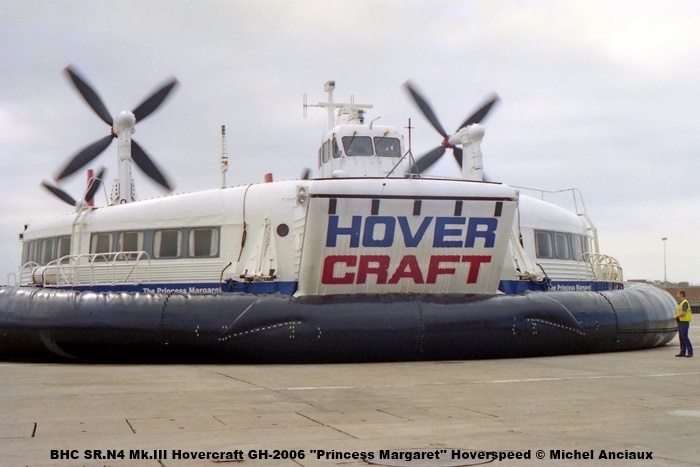
British Hovercraft Corporation SR.N4 Mk.III Hovercraft GH-2006 »Princess Margaret’’


British Hovercraft Corporation SR.N4 Mk.III Hovercraft GH-2007 »Princess Anne»

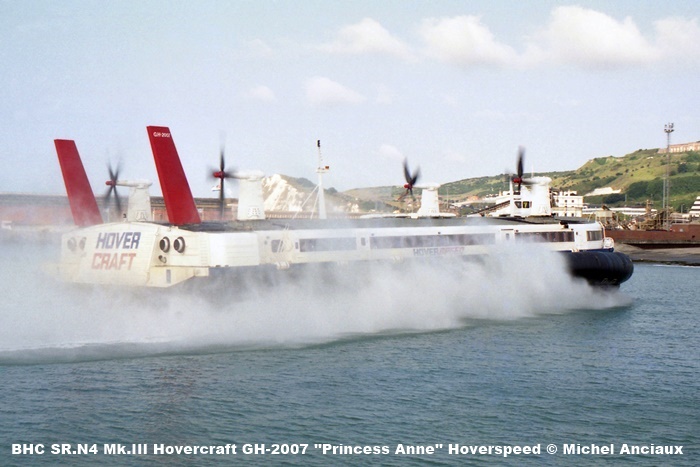


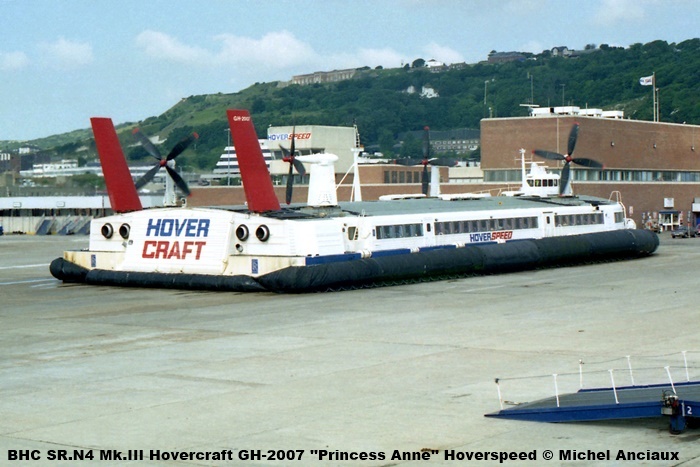

Between aircraft and ship: the British Hovercraft Corporation SR.N4 Mk.III Hovercraft
This presentation will seem out of context in a place where we spread aeronautical issues, but if I tell you that this means of transport shares certain aeronautical components, you will perhaps agree with me that it was worth presenting it.
First are the engines, a »nasalized» version of the Bristol Proteus that powered the Bristol Britannia.
As for the cockpit, if it were not for the lack of an artificial horizon, one might think that we are in an airplane. The crew consisted of a pilot, a co-pilot/»flight» engineer, and a radar operator/navigator.
Let’s also not forget that, unlike an airplane or aircraft, it moves in only two of the three dimensions of space.
The BHC-British Hovercraft Corporation, a collaboration between Saunders-Roe (a division of Westland Aircraft) and the hovercraft section of Vickers Supermarine, was a British company created in 1966 with the project of producing an economically and feasible hovercraft means of transport.
The SR.N4 Mountbatten was the most prominent mixed passenger/vehicle transport produced at the BHC and is considered to be the largest hovercraft operating in the civilian sector.
The models produced were used in commercial services across the English Channel, between August 1968 and October 2000.
The studies and works began in 1965 for the first version, with a capacity of 254 passengers and 30 cars (SR.N4 Mk.I Hovercraft). Its dimensions were 40 meters (131 ft) long with a weight of 193 tons and a top speed of 83 knots (154 km/h) or a cruising speed of 60 knots (111 km/h).
The prototype, identified as 001, was built in the same hangar where the three Saunders-Roe Princess amphibious aircraft were assembled.
In October 1967, it was presented to the press, representatives of potential clients and government officials.
November 20 marked the first engine test and on February 4 it was launch into the water for the first time. It was this same day that 001 made its «first flight».
The SR.N4 was powered by 4 Bristol Proteus turboprop engines of 3400 horsepower, being increased to 3800 in the latest Mk.III version.
Each engine came with a set of 5.8m or 19ft diameter (6.4m or 21ft on the Mk.III) steerable Dowty Rotol propellers mounted in two pairs on pylons positioned on top of the deck, being in these years the largest propellers in the world.
To mention the Bristol Proteus Engine is to cover more than 50 years of development, production and operation of this emblematic engine, related to major projects and aircraft designs produced in England: the Bristol Brabazon Mk.II in 1946, the Saunders-Roe SR. 45 Princess and Bristol 253 Britannia in 1952 but also a Proteus 705 specially modified for Donald Campbell’s Bluebird-Proteus CN7 land speed record car in 1960.
Other applications were in energy production for power plants; and of course, the Marine Proteus for the Hovercraft SR.N4 and the Brave-class fast patrol boat.
The hovercraft’s cockpit looked a lot like the one of an aircraft. The main responsibility for the radar operator/navigator was to control the navigation route with the help of the Decca 629 radar, in order to avoid possible collisions.
Even if the flight controls looked a lot like those on an airplane, with rudder pedals, rudder control sticks, yokes, separate propeller pitch levels, and engine speed controls; their functionalities differ significantly.
To complete, a 12 ton weight skirt placed under the entire perimeter of the ship, helped create the air cushion effect.
Flexible bags storing the fuel were placed in the four corners of the SR.N4 and could be used to balance the ship, transferring the fuel between the forward and aft tanks to balance and stabilize it based on the load carried but also to face with more security the climatic conditions of the moment.
The ship could navigate with wind conditions up to force 8 on the Beaufort scale and swells of 3.5m.
FORCE 8; storm
wind speed between 34-40 knots/ 62-74 km/h. Sea with waves up to 3.5m high.
Stormy and dangerous conditions for navigation
A system of double doors in the stern allowed the loading and unloading of the vehicles. A second cargo door system, in the form of a ramp, was installed in the bow.
The first commercial service with the SR.N4 was inaugurated in August 1968, using the GH-2006 »Princess Margaret» in the colors of the Seaspeed company between Dover and Boulogne; but with the delivery of other hovercraft, connections between Ramsgate and Calais They were also inaugurated.
The journey from Dover to Boulogne was approximately 35 minutes, as opposed to 1h30 by boat. Operating up to 6 trips a day in high seasons.
In the Hoverlloyd company, most of the commercial staff and crew members were hired in the air transport sector, being one opportunity among others for the British Eagle staff after its bankruptcy in 1968. So, the Hovercraft transport company operated more as an airline than as a shipping company.
As a point of interest, it is worth mentioning that the fastest journey operated by a commercial hovercraft through the English Channel was recorded on September 14, 1995 in a time of 22 minutes, with the SR.N4 Mk.III GH-2007 Princess Anne.
The Royal Navy studied the possibility of a minesweeping version of the SR.N4, the hovercraft being nearly invulnerable to mines. But it also faced the costs of operating this medium.
Throughout its years of operations, it was requested to increase the transport capacity resulting in 1973-1974 in a first variant (SR.N4 Mk.II Hovercraft) with 278 passengers and 36 cars, but without changing the structure of the initial model. The increase in capacity was possible thanks to some reconditioning of the passenger cabins.
And in February 1977 a second variant (Mk.III) was developed, using the GH-2007 Princess Anne which, through expansion works, lengthened of the structure of the ship by 16.7 m (54.2 ft) resulting in almost double the transport capacity in both passengers and vehicles.
Even if a few benign incidents occurred throughout its operations, in March 1985 it had to deplore 4 fatalities when the »Princess Margaret» collided with a pier at the entrance to the port of Dover due to weather conditions with rough seas force between 6 and 7.
These means of transport were not very profitable due to the high costs of maintenance and fuel, which had given them a first blow with the oil crisis in 1973.
In 1981, in order to continue operations, it was necessary to merge the two companies, namely Seaspeed and Hoverlloyd.
Hoverspeed, the new entity, continued with the services using 6 SR.N4 Mountbatten of various types and a SEDAM N500 Naviplane.
The commissioning of the Channel Tunnel in 1994 was a serious competition for Hoverspeed operations but the final blow came in July 1999 with the suppression of duty free sales, as a result of the new rules of customs tariffs of the European Union.
The final blow came in July 1999 with the suppression of duty-free sales, as a result of the new customs pricing rules of the European Union.
These sales on board had been a financial contribution of some importance to the company.
An example to support this statement was that in 1979, 30% of operating profits came from duty-free sales.
The last SR.N4s, namely the Princess Anne and Princess Margaret, were retired on October 1, 2000, and the Hoverspeed company ceased operations on November 7, 2005.
The GH-2007 »Princess Anne» is the only example still in existence and is preserved at the Hovercraft Museum in Lee-on-Solent, about 28 km south-east of Southampton.
Airfix, an English scale modelling company, produced in the 1970s a model of the SR.N4 Mk.II »Swift» with transparent parts to show the details of the interior.
uk.airfix.com/community/forum/airfix-1144-bhc-srn4-hovercraft-09171?ccm_paging_p=3
http://www.modelshipgallery.com/gallery/misc/hoover/SRN4-144-rp/pages/IMG_2530.htm
A total of six ships, in 3 models, operated between 1968 and 2000
The Mk.I who were the first versions came out in 1967. They had a lengt of 39.68 m and a weight of 165 t. Its cruising speed reached 40-50 knots (74-93 km/h) but could reach 60-65 knots (111-120 km/h).
The second versions were the Mk.II which came out in 1972. One of the first was the GH-2005 »Sure», followed by the GH-2004 »Swift» in 1973 and the GH-2008 »Sir Christopher » in 1974.
As for the GH-2054 »The Prince of Wales», it was built as a MK.II model.
The MK.II had the same measurements as the first models but weighed 200 T.
Its cruising speed reached 40-65 knots (74-120 km/h) but could reach up to 70 knots (130 km/h).
Its transport capacities were 278 passengers and 36 cars.
The last version was the MK.III in 1978, becoming the GH-2006 »Princess Margaret» and GH-2007
»Princess Anne».
These 2 models had a length of 56.38 meters and a weight of 320 t. Its transport capacities were 418 passengers and up to 60 cars.
Its cruising speed reached 60-65 knots (111-120 km/h) but could reach up to 83 knots (154 km/h).
Michel Anciaux
 Aviation Rainbows
Estimado don Michel
Muy interesante artículo sobre un medio de transporte hoy en día casi por completo olvidado, pero que en su época marcó una tendencia.-
Creo que el Eurotúnel y los trenes de alta velocidad fueron las causas de su desaparición.-
Un abrazo
Sergio Barriga Kreft
Me gustaMe gusta