
Translation in englis available at the bottom

En base a las fechas de entregas a la compañía así que ,de sus retiros de la flota de la misma compañía, podemos decir que DAT Delta air Transport de Bélgica fue una de las últimas líneas aéreas europeas, con Finnair, SAS y Linjeflyg, en operar aviones con motores radiales en vuelos regulares de transportes de pasajeros.
Estamos en los años 1967 a 1977 y los aviones utilizados eran Douglas DC-3/C-47 y Convair 440 Metropolitan.
Todo empezó en 1966, de forma bien singular cuando el señor Frans Van den Bergh, un promotor inmobiliario en Amberes dedicado a la venta de terrenos la construcción de mansiones en el sur de Francia, Cerdeña e Italia compro un Cessna 210F con matricula OO-VDB con el fin de ofrecer a los potenciales compradores una visita personalizada en avión privada.
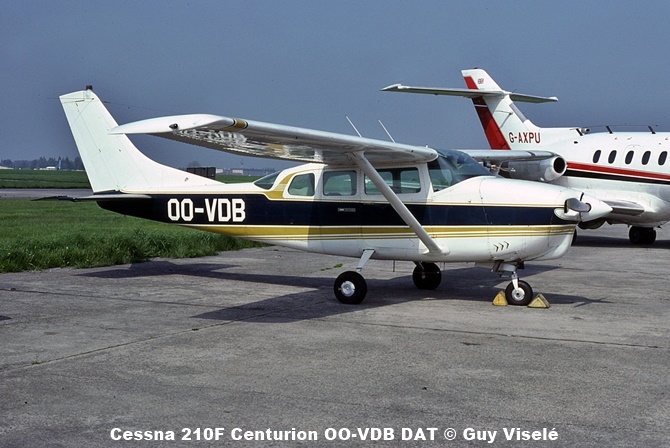
A lo largo y convencido en el concepto de aviones taxi que ofrecen servicios personalizados, mayor flexibilidad en los horarios y con destinos no operados por compañías aéreas regulares, el 16 de junio de 1966, el señor Van den Bergh fundo Delta Air Taxi con base en Amberes con asistencia de amigos gentes inmobiliarios, Frans Van den Bergh siendo presidente de la compañía.
El origen del acrónimo DAT está en el código de radio Víctor DELTA Bravo, matrícula del primer del avión, pero se convirtió en poco tiempo en Delta Air Transport.
Con el éxito de las operaciones de vuelos se vio la necesidad de agregar un Cessna U206 Skywagon y el Cessna 337 Super Skymaster OO-VDA.


Con el fin de rentabilizar la flota de aviones, estos fueron utilizados también para el transporte de flores, tomates y pescado, especialmente entre Ostende y Lieja, pero estos servicios de carga generaron pérdidas frente a la competencia del transporte por carretera, siendo entonces abandonado.
En 1967, Sabena toma la decisión de suspender sus servicios de Helicópteros operados con Sikorsky S-58. Es de recordar que la compañía aérea de bandera belga había iniciado los primeros servicios de transportes de pasajeros en el continente europeo con modelos S-55 y luego S-58 entre 1953 y 1967.
Como no disponía en su flota aviones de semejante capacidad para tramos de vuelos cortos que se operaba en su tiempo con los helicópteros, Sabena vio la solución de confiar estas operaciones a pequeñas empresas, con aviones adecuados. DAT se presentó como candidato para los vuelos a Rotterdam y Eindhoven, en los Países Bajos y con este fin, adquirió dos Beech 65-B80 Queen Air con matrículas OO-VDD y OO-VDE en abril y septiembre de 1967
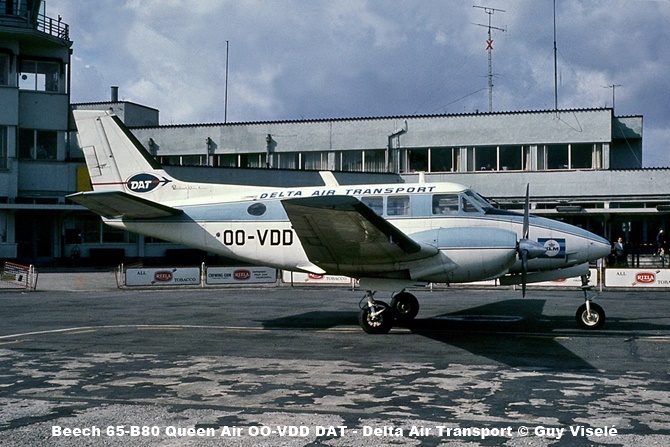
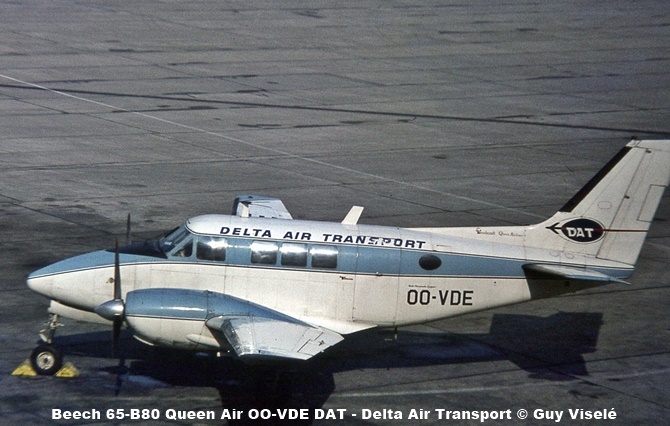
pero en un primer tiempo el contrato fue atribuido a BIAS – Belgian International Air Service con un De Havilland DH.114 Heron 1B matriculado OO-BIA.

Los Beech por su parte siguieron con los vuelos para clientes potenciales del señor Van den Bergh al sur de Francia y Cerdeña y iniciaron vuelos regulares a Bremen, Hannover y Hamburgo, pero fueron rápidamente suspendidos debido a la competencia de Sabena.
El De Havilland Heron de BIAS que operaba los vuelos Sabena tiene fallas técnicas regulares resultando en la DAT haciendo los reemplazos de vez en cuando en estas operaciones y finalmente obteniendo el contrato, lo que necesitó de pintar el Beech OO-VDD en los colores de la compañía aérea nacional.

En el mismo tiempo se consiguió un contrato que cambiaría en forma radical el futuro de la DAT.
En 1967, Freddy Van Gaever dueño de una empresa de transporte vía carretera, con conexiones a la CMB – Compañía Marítima Belga se interesó en la línea aérea de Amberes, con la intensión de invertir mayores capitales y así poder apoyar su expansión. Y fue el que trajo el contrato de valor inestimable que había conseguido de la KLM para operar 2 vuelos diarios de transporte de pasajeros entre Amberes y Ámsterdam utilizando el Beech Queen Air. El primer vuelo se realizo el 17 de septiembre del mismo año. Los vuelos eran tan exitosos que a las semanas de su inauguración era obvio que las demandas de pasajes sobrepasaban la capacidad de asientos disponibles en los vuelos operados.
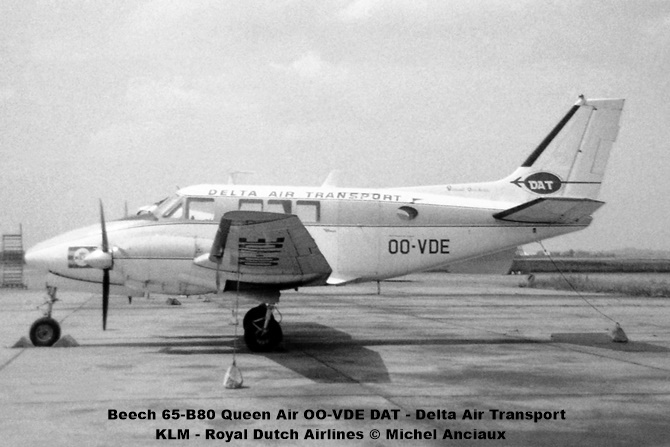
Debida a esta situación, el señor Van Gaever vio la necesidad de incorporar aviones de mayores capacidades y eligió el DC-3, único avión que podía satisfacer las capacidades necesarias en la ruta operada pero también disponible en forma directo en el mercado de segunda mano.
El primer Douglas en llevar el logo y identidad de la compañía fue el OO-VDF, quien llegó en Amberes en julio de 1967 y entro de inmediato en los programas de vuelos de KLM.


El VDF había sido comprado en los Países Bajos donde operó con la entonces desaparecida Schreiner Airways, con matrícula PH-DAC. Es de señalar que el OO-VDF no solamente fue el primero DC-3 en volar con DAT, pero también fue el último en dejar la compañía en agosto de 1973 cuando los Douglas fueron remplazados por los Convair 440.
Este DC-3 no solamente volaba de día en los vuelos de pasajeros, también operaba vuelos cargueros en horarios de noche desde Ámsterdam, por cuenta de KLM.
Pero el éxito de la Ruta KLM a Amberes y la necesidad de un tercer vuelo significó la compra de un segundo avión en septiembre de 1968, siendo este un ex SABENA con matrícula OO-AUX.
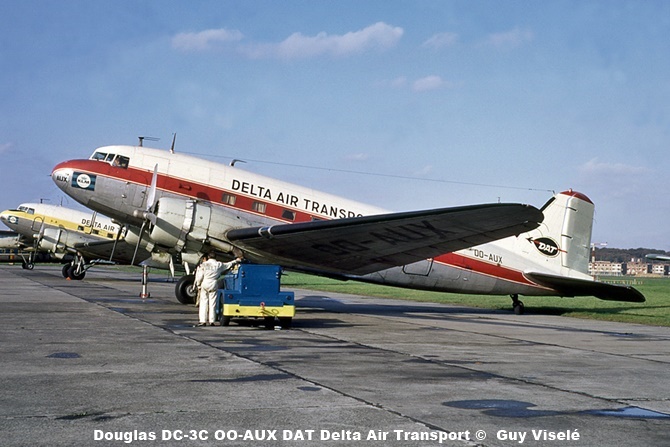
Sus operaciones con la DAT fueron de corto tiempo. El 8 de mayo de 1970 choco con un generador en la plataforma de aeropuerto de Schiphol en la salida de su vuelo KL037 a Bruselas.
Los daños fueron de consideración, afortunadamente sin víctimas para la tripulación y los pasajeros igual si la hélice atravesó el fuselaje justo detrás del puesto de mando. Con reparaciones provisorias fue llevado en vuelo de ferry a Amberes, siendo este el último vuelo para el OO-AUX debido a los costos prohibitivos de la reparación así que fue utilizado como fuente de repuestos.
Con la llegada del OO-CBU en marzo de 1969, también un ex SABENA, una cuarta frecuencia de vuelo fue agregada entre Ámsterdam y Amberes.
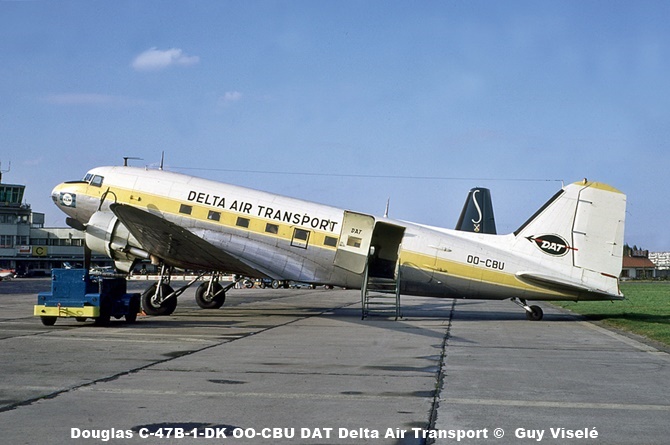
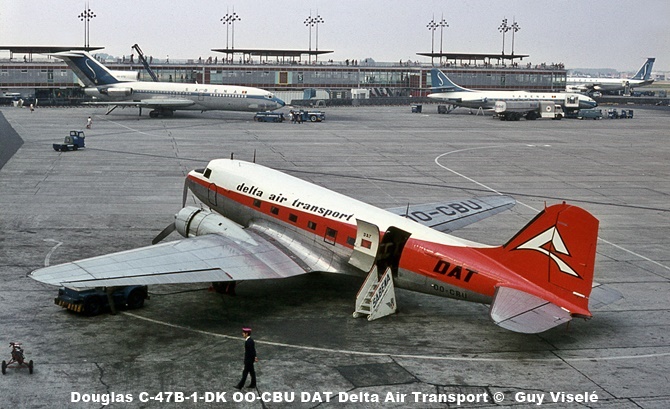
En 1970 la empresa fue adquirida por la CMB – Compañía Marítima Belga, cambiando a un atractivo diseño de colores naranjo, blanco y negro que fueron los esquemas de colores corporativos de esta Company naviera.
La llegada de nuevos capitales resulto en la compara de aviones adicionales siendo 4 a lo largo del año 1971. Delta Air Transport operaba los vuelos a Eindhoven y Bruselas – Amberes por cuenta de SABENA.
Como lo comentaba el investigador aeronáutico belga Fernand Van de Plas, este vuelo de una distancia de 50 km podría haber sido uno de los más cortos en DC-3 del continente, publicado en los horarios IATA de la época. También solía ser popular para alguien que quería ofrecer o efectuar un primer vuelo en avión y sobre todo sentir las reales emociones de este vuelo.
Finalmente, un total de 8 Douglas DC-3 serán matriculados con DAT Delta Air Transport entre julio de 1967 y julio de 1971.

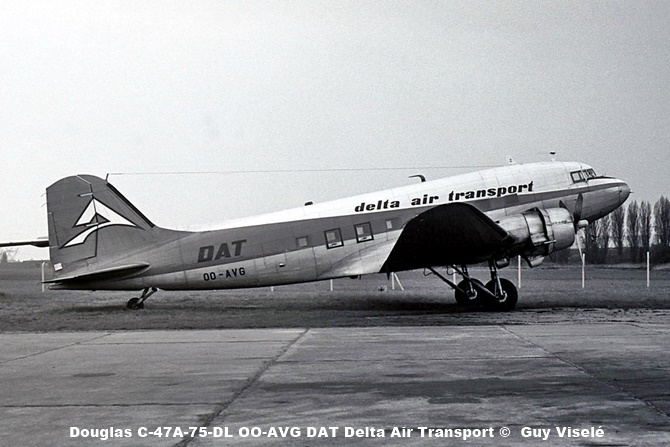

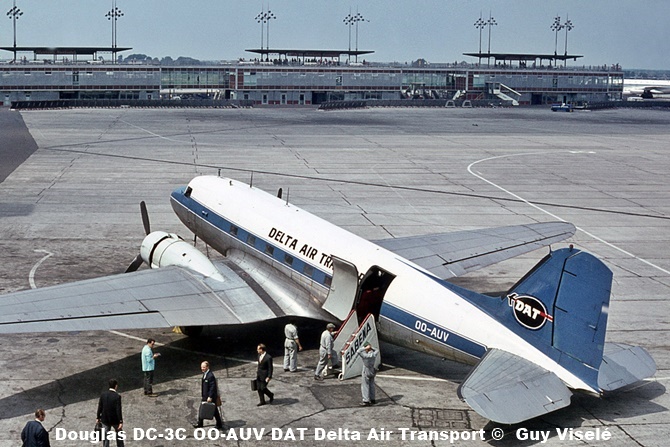

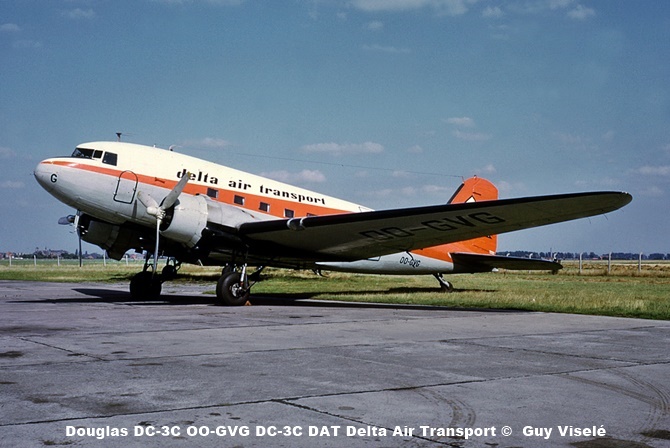
Con 6 DC-3 en operación, la línea Aerea podía operar vuelos regularte por cuenta de la KLM y SABENA, pero también vuelos chárteres y de carga.
El retiro de estos valientes materiales de vuelo ocurrió en el 1972, con la necesidad para la DAT de ofrecer un avión con mejor comodidad y sobre todo una cabina presurizada, siendo esto el requisito de la KLM.
Un paréntesis fue que con el fin de cumplir con el contrato KLM de vuelos nocturnos de carga, DAT se vio en la necesidad de arrendar el C-47A-10-DK PH-MAG de Moormanair Holland para la temporada de invierno 1972.

Douglas C-47
OO-VDF to C9-ATH
OO-AUX DBR in Ams on 8/05/197
OO-CBU operated for over 2 years and sold for spare to Kestrel Aviation
OO-AVG to N3433E
OO-KVG to N3433P, N513AC
OO-AUV to N3433U, N222PV, YV-98C, YV-609C
OO-GVG to N3433H
OO-DVG to N3433Y, w/o 18/03/94 Spokane, WA
Seis aviones en operación, desde 1967 hasta 1972.
Una oportunidad se presento en la puesta a la venta, por parte de Iberia, de su flota de Convair 440, siendo estos substituidos por el Fokker F-27 en las rutas interinsulares de la compañía español.
5 Convair Metropolitan fueron adquiridos, 4 llegando a Amberes ente el 27 de mayo de 1972 y el 20 de agosto del mismo año, El quinto avión fue utilizado para repuesto y luego desguazado en Madrid en abril 1973.
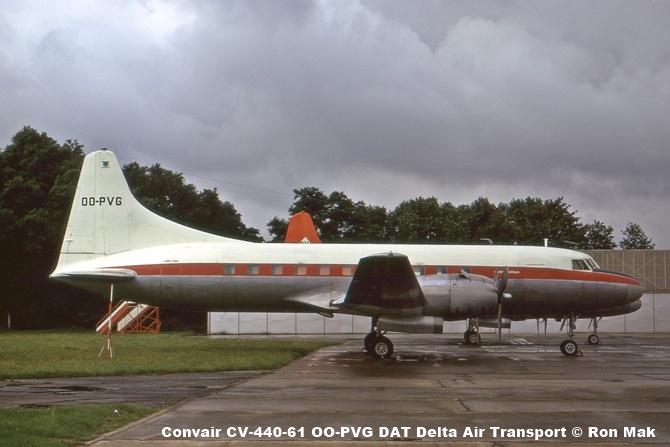
El problema con la puesta en servicio de estos aviones fue el entrenamiento de los pilotos ya que Iberia podía organizar un curso, pero en español. Finalmente, y luego de contactar con SABENA,
y KLM que habían operados este tipo de avión, pero no tenían mas archivos fue la compañía escandinava SAS quien pudo dar un curso en inglés.
El vuelo inaugural, con los Convair 440 OO-TVG y OO-UVG, fue el 24 de agosto de 1972 a Ámsterdam y a partir del 25 del mismo mes, todos los vuelos regulares fueron operados con los Convair Metropolitan.
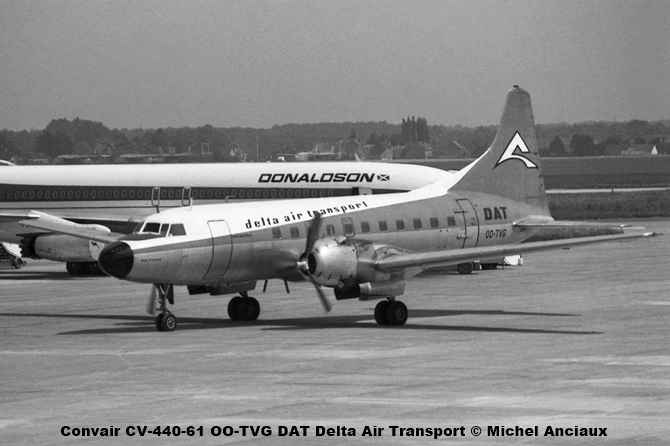
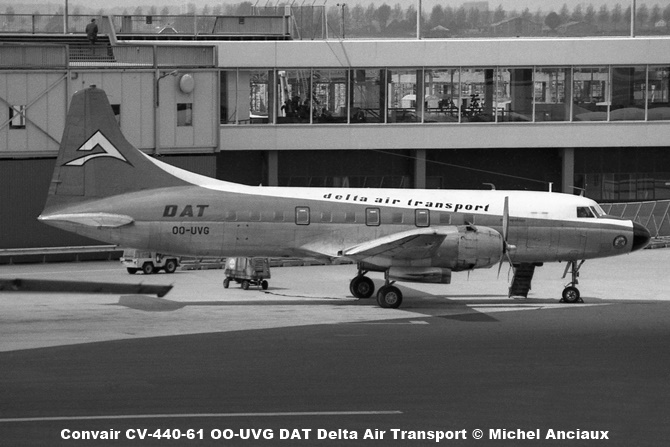
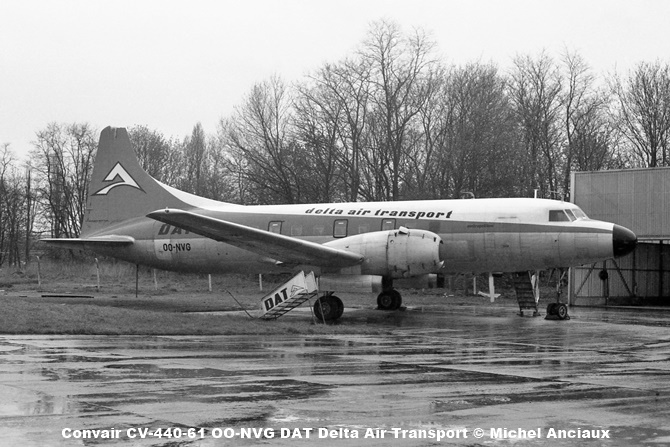
El cuarto Convair ex Iberia llego el 20 de agosto recibiendo su matrícula oficial OO-NVG, pero no estaba destinado a volar en las rutas de la compañía belga. La razón fue que se necesitó un mantenimiento completo del sistema y Rueda de nariz y en lugar de invertir capitales en este costoso trabajo se tomo la decisión de retirar el avión del servicio y utilizarlo como fuente de repuestos para los otros aviones de la flota Convair.

Para los horarios de vuelos KLM para la temporada invierno 72-73 se anunciaba 8 vuelos diarios entre Ámsterdam y Amberes reducidos a 4 para el domingo.
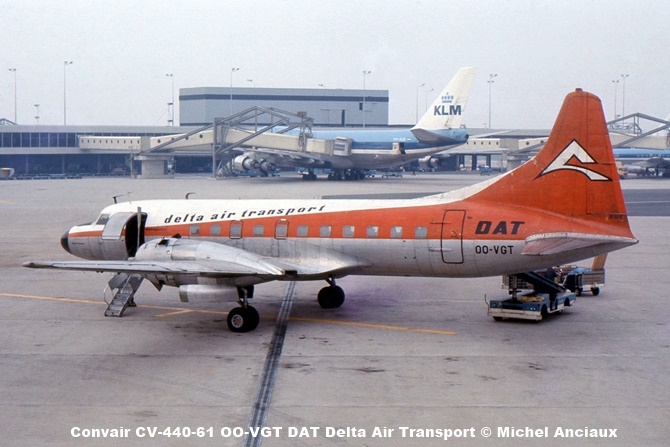

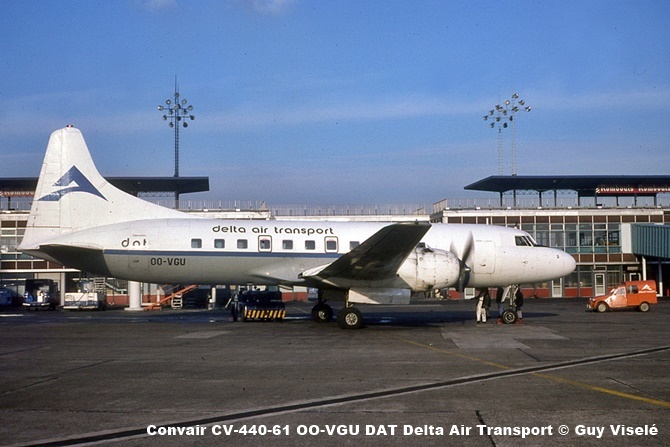
El año 1974 trajo nuevas expansiones para la DAT. KLM programó 3 vuelos diarios entre Bruselas y Ámsterdam, utilizando los Convair DAT. Con el fin de poder cumplir con las operaciones, la Delta Air Transport se vio en la necesidad de agregar 2 aviones a su flota.
El primero de esto se consiguió en África donde fue utilizado como avión presidencial en … Cameron.
Llego a su nueva base en Amberes el 20 de marso. Recibiendo la matricula belga OO-VGJ.

Se diferenciaba de los otros miembros de la flotan por su radar de nariz mas pequeño que la nariz tradicional de los Convair 440 en uso.
El ultimo Convair en completar el inventario de flota de los CV440 Metropolitan fue un ex Luftwaffe que llego el 8 de agosto de 1974, recibiendo la matricula OO-VGW.
A partir de abril 1975 SABENA operó el tramo Bruselas- Dusseldorf a razón de 2 vuelos por día, utilizando los Convair de la DAT celebrando así el retorno de este avión en los horarios de compañía nacional, a 8 años de su retiro. Sabena había utilizado 12 modelos en los años 1953 a 1968.

Convair 440
OO-NVG ex EC-ATE, to OO-VGN than OO-NVG, used for spare
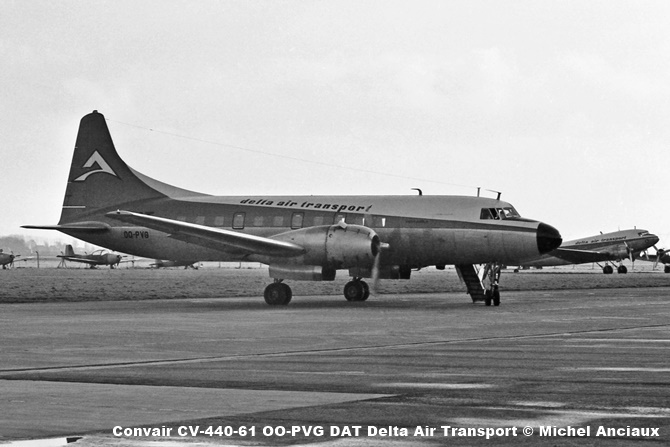
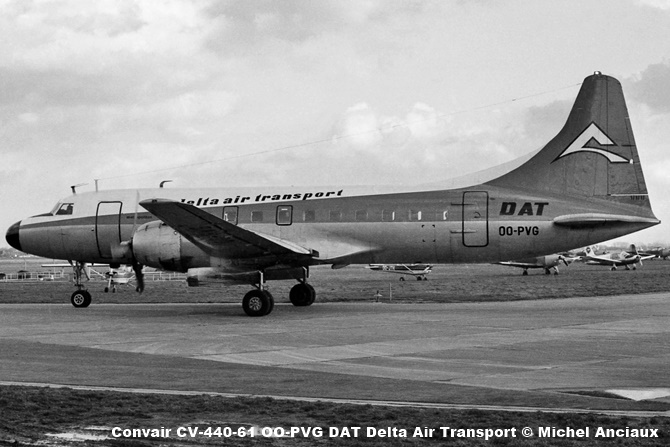
OO-PVG Rereg OO-VGP to N44828, w/o 16/12/84 Jasper, AL
OO-TVG Rereg OO-VGT to N44825, to Museum of Flying Santa Monica, CA
OO-UVG Rereg OO-VGU to N44826
OO-VGJ to N44829, XA-TFZ
OO-VGW to HB-IMU, N847TA, XB-CSE, XA-RYV
EC-ARS para fuete de repuestos
Seis aviones en operación, desde 1972 hasta 1977.
En 1977, se consideró el reemplazo de la flota debido a las presiones de la compañía holandés que requería materiales más modernos para ofrecer un servicio de calidad.
2 factores presentaban restricciones en la selección de los futuros aviones. La primera siendo el largo de pista disponible en el aeropuerto de Amberes – Deurne y para la segunda se consideraba el tiempo de vuelo entre Bruselas o Amberes y Ámsterdam.
En un primer tiempo se tomó en arriendo 2 Nord 262 de la compañía daneses Cimber Air los vuelos de Amberes a Ámsterdam, apoyando así los Convair 440.

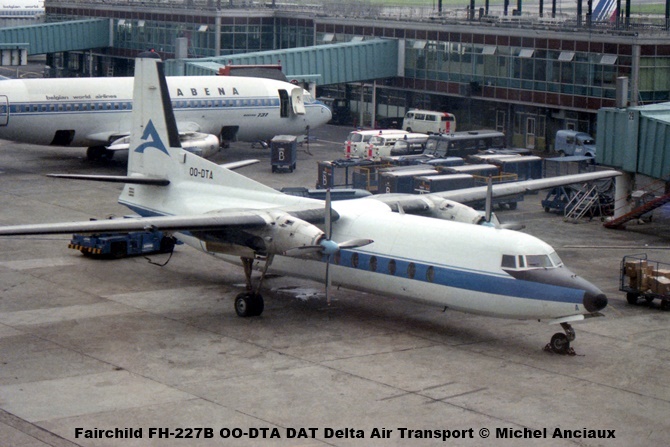
Finalmente, luego de un exhaustivo estudio y búsqueda, se tomó la decisión de comprar 4 Fairchild-Hiller FH-227B a la compañía americana Ozark Airlines, llegando a la base de la DAT entre marzo y mayo de 1977.

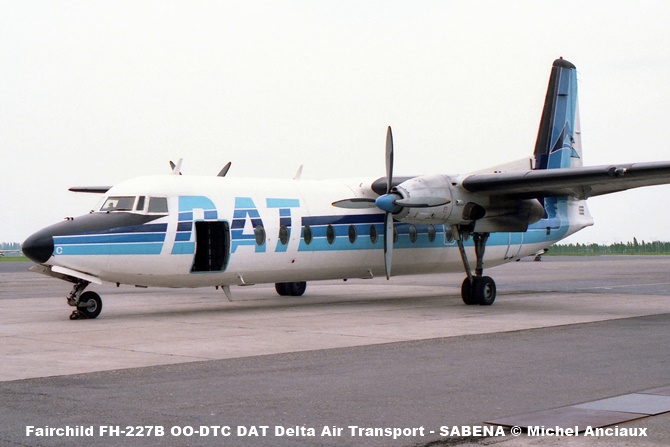
En mayo de 1981, un quinto modelo, ex Allegheny Airlines y Pan Adria Airways se sumó a la flota.
La incorporación de estos aviones marcó el comienzo del retiro de los Convair y un cliente del más sorprendente se interesó en los 4 aviones aun en operación. Se trata de American Airlines y eso a consecuencia de lo siguiente.
El 27 de abril de 1976, el vuelo 625 de American Airlines procediendo desde Nueva York – JFK y destino a St Thomas, en las Islas Virgen, se accidentó al aterrizaje en la isla con la muerte de 37 pasajeros. El accidente se debe a una acumulación de errores por parte de la tripulación, combinado con condición de tiempo desfavorables en el momento del aterrizaje. Además, la configuración del aeropuerto era considerada marginal para operaciones con aviones jet y solo pilotos con calificaciones adecuadas para estos vuelos operados con Boeing 727 especialmente equipados con frenos de ruedas de nariz estaban autorizados.
A consecuencia de esta tragedia y bajo presión del sindicato de pilotos, American Airlines suspendió los vuelos e inauguró una compañía subsidiaria para efectuar el transfer de pasajeros entre las islas de St Croix y St Thomas.
En marzo 1977, American Inter-Island firmó el contrato de compra con la DAT para la adquisición de los aviones Convair. El primer en iniciar el vuelo de traslado a los Estados Unidos fue el OO-VGT quien partió desde Amberes el 9 de marzo. Siguieron el OO-VGU el 30 de abril, el OO-VGP el 4 de junio y el ultimo en partir siendo el OO-VGJ con fecha el 19 der junio, significando el fin de un fabuloso periodo de propliners para la Delta Air Transporte y el Aeropuerto de Amberes ya que los siguientes residentes en ocupar la plataforma de este mismo aeropuerto serían los Fairchild FH-227B.
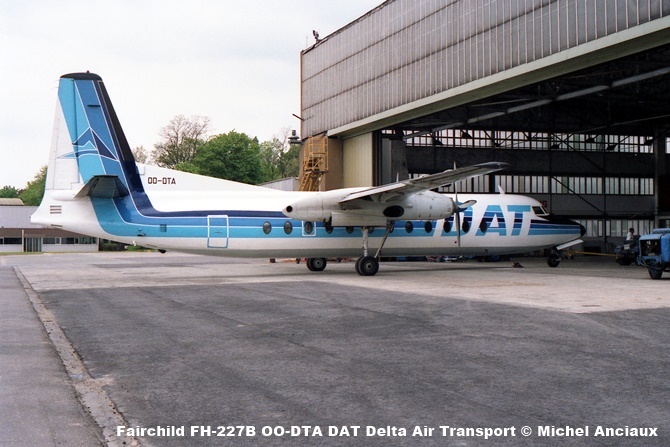

Es de recordar que DAT había también utilizado 6 Douglas DC-6 pero solamente en vuelos chárteres
Por esta razón no los consideré en la presentación de este reportaje.
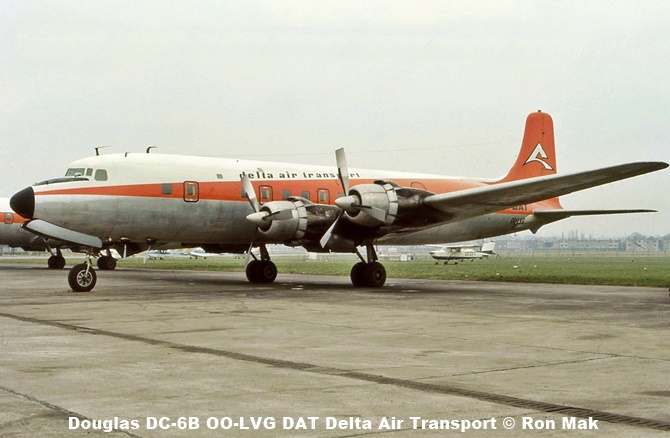

Douglas DC-6
OO-BVG Rereg OO-VGB w/o 04/10/74 Southend ex LN-MTU
OO-EVG Rereg OO-VGE to C-GHLY, N501ZS & N651CE
OO-FVG ex OO-PAY Rereg OO-VGF to C-GHLZ & N444CE
OO-LVG Rereg OO-VGL to C-GICD, N151 & LN-SUB for preservation Flyhistorisk Museum Sola
OO-RVG to N3449H, C-GBYH & N6204U
OO-VFG to N9383A, EC-DCK & 9Q-CCM
OO-VGK to C-GIOY
OO-CTK to N94491 & TR-LTY
F-BRID nunca entró en servicio
OH-KDC nunca entró en servicio y destruido por un incendio 02/01/74
Ocho aviones en operación desde 1971 hasta 1977 (para el último)
Michel Anciaux
Fuentes de informaciones
Quiero expresar mis profundos agradecimientos a Guy Viselé por su grande en informaciones y archivo fotográficos
También Ron Mak fue de grande ayuda en informaciones y archivos fotográficos
Magazine Propliner n°78 Spring 1999 Delta Air Transport and the DC-3 Fernand Van de Plas.
Magazine Propliner n°82 Spring 2000 Delta Air Transport’s Finest hour Fernand Van de Plas.
Magazine Propliner n°87 Summer 2001 The Delta Metropolitan Line Fernand Van de Plas.
https://en.wikipedia.org/wiki/Delta_Air_Transport
DAT – Delta Air Transport by Luc Barry Febrero 2021
DAT – Delta Air Transport and the operations of the Douglas DC-3 and Convair 440 Metropolitan.
Based on the dates of deliveries to the company as well as its withdrawals from the fleet of the same company, we can say that DAT Delta air Transport of Belgium was one of the last European airlines, with Finnair, SAS and Linjeflyg, to operate airplanes with radial engines on regular passenger flights.
We are in the years 1967 to 1977 and the aircraft used were Douglas DC-3/C-47 and Convair 440 Metropolitan.
It all started in 1966, in a very unique way when Mr. Frans Van den Bergh, a real estate developer in Antwerp, dedicated to the sale of land and the construction of mansions in the south of France, Sardinia and Italy, bought a Cessna 210F with registration OO-VDB. in order to offer potential buyers a personalized visit by private plane.
Convinced in the concept of taxi planes that offer personalized services, greater flexibility in schedules and with destinations not operated by regular airlines, on June 16, 1966, Mr. Van den Bergh founded Delta Air Taxi based in Antwerp; with the assistance of real estate friends, Frans Van den Bergh being president of the company.
The origin of the acronym DAT is in the Víctor DELTA Bravo radio code, registration of the first plane, but it soon became Delta Air Transport.
With the success of flight operations, there was a need to add a Cessna U206 Skywagon and the Cessna 337 Super Skymaster OO-VDA.
In order to make the aircraft fleet profitable, these were also used to transport flowers, tomatoes and fish, especially between Ostend and Liège, but these cargo services generated losses in the face of competition from road transport, and were then abandoned.
In 1967, Sabena made the decision to suspend its helicopter services operated with Sikorsky S-58. It is worth remembering that the Belgian flag carrier had begun the first passenger transport services on the European continent with S-55 and then S-58 models between 1953 and 1967.
As it did not have aircraft with similar capacity in its fleet for short flight segments that were operated in its time with helicopters, Sabena saw the solution of entrusting these operations to small companies, with suitable aircraft. DAT presented itself as a candidate for flights to Rotterdam and Eindhoven, in the Netherlands and for this purpose, acquired two Beech 65-B80 Queen Air with registrations OO-VDD and OO-VDE in April and September 1967 but at first, the contract was awarded to BIAS – Belgian International Air Service with a De Havilland DH.114 Heron 1B registered OO-BIA.
The Beech’s, for their part, continued flights for Mr Van den Bergh’s potential clients to the south of France and Sardinia and started regular flights to Bremen, Hannover and Hamburg, but they were quickly suspended due to competition from Sabena.
The BIAS de Havilland Heron that operated the Sabena flights has regular technical failures resulting in the DAT making replacements from time to time on these operations and finally obtaining the contract, which necessitated painting the Beech OO-VDD in the colors of the national airline company.
At the same time, a contract was obtained that would radically change the future of the DAT.
In 1967, Freddy Van Gaever, owner of a road transport company, with connections to the CMB – Belgian Maritime Company, became interested in the Antwerp airline, with the intention of investing greater capital and thus being able to support its expansion. And he was the one who brought in the priceless contract that he had gotten from KLM to operate 2 daily passenger transport flights between Antwerp and Amsterdam using the Beech Queen Air. The first flight took place on September 17 of the same year. The flights were so successful that within weeks of their inauguration it was obvious that the demands for tickets exceeded the capacity of seats available on the operated flights.
Due to this situation, Mr. Van Gaever saw the need to incorporate aircraft with greater capacities and chose the DC-3, the only aircraft that could satisfy the necessary capacities on the operated route but also available directly on the second-hand market.
The first Douglas to carry the company’s logo and identity was the OO-VDF, which arrived in Antwerp in July 1967 and immediately entered KLM’s flight programs.
The VDF had been purchased in the Netherlands where it operated with the then defunct Schreiner Airways, with registration PH-DAC. It should be noted that the OO-VDF was not only the first DC-3 to fly with DAT, but it was also the last to leave the company in August 1973 when the Douglas were replaced by the Convair 440.
This DC-3 not only flew during the day on passenger flights, it also operated cargo flights at night from Amsterdam, on behalf of KLM.
But the success of the KLM route to Antwerp and the need for a third flight meant the purchase of a second aircraft in September 1968, this being a former SABENA with registration OO-AUX.
His operations with the DAT were short-lived. On May 8, 1970, he collided with a generator on the Schiphol airport apron, on departure of his flight KL037 to Brussels.
The damage was considerable, fortunately there were no casualties for the crew and passengers, even if the propeller crossed the fuselage just behind the cockpit.
With temporary repairs it was taken by ferry flight to Antwerp, this being the last flight for the OO-AUX due to the prohibitive costs of the repair so it was used as a source of spare parts.
With the arrival of OO-CBU in March 1969, also a former SABENA, a fourth flight frequency was added between Amsterdam and Antwerp.
In 1970 the company was acquired by the CMB – Belgian Maritime Company, changing to an attractive orange, white and black colour scheme that were the corporate colour schemes of this shipping company.
The arrival of new capital resulted in the purchase of additional aircraft, 4 throughout 1971. Delta Air Transport operated flights to Eindhoven and Brussels – Antwerp on behalf of SABENA.
As the Belgian aviation researcher Fernand Van de Plas commented, this flight of a distance of 50 km could have been one of the shortest DC-3 flights on the continent, published in the IATA schedules of the time. It also used to be popular for someone who wanted to offer or take a first plane flight and above all feel the real emotions of this flight.
Finally, a total of 8 Douglas DC-3s will be registered with DAT Delta Air Transport between July 1967 and July 1971.
With 6 DC-3s in operation, the airline could operate regular flights on behalf of KLM and SABENA, but also charter and cargo flights.
The retirement of these brave flight materials occurred in 1972, with the need for DAT to offer an aircraft with better comfort and, above all, a pressurized cabin, this being the requirement of KLM.
A parenthesis was that in order to fulfill the KLM contract for night cargo flights, DAT found it necessary to lease the C-47A-10-DK PH-MAG from Moormanair Holland for the 1972 winter season.
Douglas C-47
OO-VDF to C9-ATH
OO-AUX DBR in Ams on 8/05/197
OO-CBU operated for over 2 years and sold for spare to Kestrel Aviation
OO-AVG to N3433E
OO-KVG to N3433P, N513AC
OO-AUV to N3433U, N222PV, YV-98C, YV-609C
OO-GVG to N3433H
OO-DVG to N3433Y, w/o 18/03/94 Spokane, WA
Six aircraft in operation, from 1967 to 1972
An opportunity arose in the sale, by Iberia, of its fleet of Convair 440, these being replaced by the Fokker F-27 on the inter-island routes of the Spanish company.
5 Convair Metropolitans were acquired, 4 arriving in Antwerp between May 27, 1972 and August 20 of the same year. The fifth aircraft was used for spare parts and then scrapped in Madrid in April 1973.
The problem with the commissioning of these aircraft was the training of the pilots, since Iberia could organize a course, but in Spanish. Finally, and after contacting SABENA, and KLM that had operated this type of aircraft, but had no more files, it was the Scandinavian company SAS that was able to give a course in English.
The inaugural flight, with the Convair 440 OO-TVG and OO-UVG, was on August 24, 1972 to Amsterdam and from the 25th of the same month, all regular flights were operated with the Convair Metropolitan. The fourth Convair ex-Iberia arrived on August 20 receiving its official registration OO-NVG, but it was not intended to fly on the Belgian company’s routes. The reason was that a complete maintenance of the nose wheel system was required and instead of investing capital in this expensive work, the decision was made to remove the aircraft from service and use it as a source of spare parts for the other aircraft in the Convair fleet.
For the KLM flight schedules on the winter 72-73 season, 8 daily flights between Amsterdam and Antwerp were announced, reduced to 4 for Sunday.
The year 1974 brought new expansions for the DAT.
KLM scheduled 3 daily flights between Brussels and Amsterdam, using the Convair DAT. In order to be able to carry out operations, Delta Air Transport found it necessary to add 2 aircraft to its fleet.
The first of this was found in Africa where it was used as a presidential plane in… Cameron.
He arrived at his new base in Antwerp on March 20. Receiving the Belgian registration OO-VGJ.
It was differentiated from the other members of the fleet by its radar nose, smaller than the traditional nose of the Convair 440 in use.
The last Convair to complete the CV440 Metropolitan fleet inventory was a former Luftwaffe that arrived on August 8, 1974, receiving the registration OO-VGW.
Starting in April 1975, SABENA operated the Brussels-Dusseldorf section at a rate of 2 flights per day, using the DAT Convair, thus celebrating the return of this plane on the national company’s schedules, 8 years after its retirement. Sabena had used 12 models in the years 1953 to 1968.
Convair 440
OO-NVG ex EC-ATE, to OO-VGN than OO-NVG, used for spare
OO-PVG Rereg OO-VGP to N44828, w/o 16/12/84 Jasper, AL
OO-TVG Rereg OO-VGT to N44825, to Museum of Flying Santa Monica, CA
OO-UVG Rereg OO-VGU to N44826
OO-VGJ to N44829, XA-TFZ
OO-VGW to HB-IMU, N847TA, XB-CSE, XA-RYV
EC-ARS for spare parts
Six aircraft in operation from 1972 to 1977.
In 1977, replacement of the fleet was considered due to pressure from the Dutch company that required more modern materials to offer a quality service.
2 factors presented restrictions in the selection of future aircraft. The first being the length of runway available at the Antwerp – Deurne airport and the second being the flight time between Brussels or Antwerp and Amsterdam.
Initially, 2 Nord 262 from the Danish company Cimber Air were leased on flights from Antwerp to Amsterdam, thus supporting the Convair 440.
Finally, after an exhaustive study and search, the decision was made to buy 4 Fairchild-Hiller FH-227B from the American company Ozark Airlines, arriving at the DAT base between March and May 1977.
In May 1981, a fifth model, former Allegheny Airlines and Pan Adria Airways joined the fleet.
The introduction of these aircraft marked the beginning of the retirement of the Convair and a most surprising customer became interested in the 4 aircraft still in operation. This is American Airlines and that is as a result of the following.
On April 27, 1976, American Airlines Flight 625, proceeding from New York – JFK and bound for St Thomas, in the Virgin Islands, crashed upon landing on the island with the death of 37 passengers. The accident is due to an accumulation of errors on the part of the crew, combined with unfavourable weather conditions at the time of landing. Furthermore, the airport configuration was considered marginal for jet aircraft operations and only pilots with suitable qualifications for these flights operated with Boeing 727s specially equipped with nose wheel brakes were authorized.
As a result of this tragedy and under pressure from the pilots’ union, American Airlines suspended flights and inaugurated a subsidiary company to transfer passengers between the islands of St Croix and St Thomas.
In March 1977, American Inter-Island signed the purchase contract with DAT for the acquisition of Convair aircraft. The first to begin the transfer flight to the United States was OO-VGT, which departed from Antwerp on March 9. They followed the OO-VGU on April 30, the OO-VGP on June 4 and the last to depart being the OO-VGJ dated June 19, signifying the end of a fabulous period of propliners for Delta Air Transportation and the Antwerp Airport as the next new residents to occupying the apron of this same airport would be the Fairchild FH-227B.
It should be remembered that DAT had also used 6 Douglas DC-6s but only on charter flights.
For this reason, I did not consider them in the presentation of this report.
Douglas DC-6
OO-BVG Rereg OO-VGB w/o 04/10/74 Southend ex LN-MTU
OO-EVG Rereg OO-VGE to C-GHLY, N501ZS & N651CE
OO-FVG ex OO-PAY Rereg OO-VGF to C-GHLZ & N444CE
OO-LVG Rereg OO-VGL to C-GICD, N151 & LN-SUB for preservation Flyhistorisk Museum Sola
OO-RVG to N3449H, C-GBYH & N6204U
OO-VFG to N9383A, EC-DCK & 9Q-CCM
OO-VGK to C-GIOY
OO-CTK to N94491 & TR-LTY
F-BRID never entered service
OH-KDC never entered service and destroyed by fire 02/01/74
Eight aircraft in operation from 1971 to 1977 (for the last one)
Michel Anciaux
 Aviation Rainbows
Interesante trabajo histórico de algo que uno desconoce
Me gustaMe gusta